







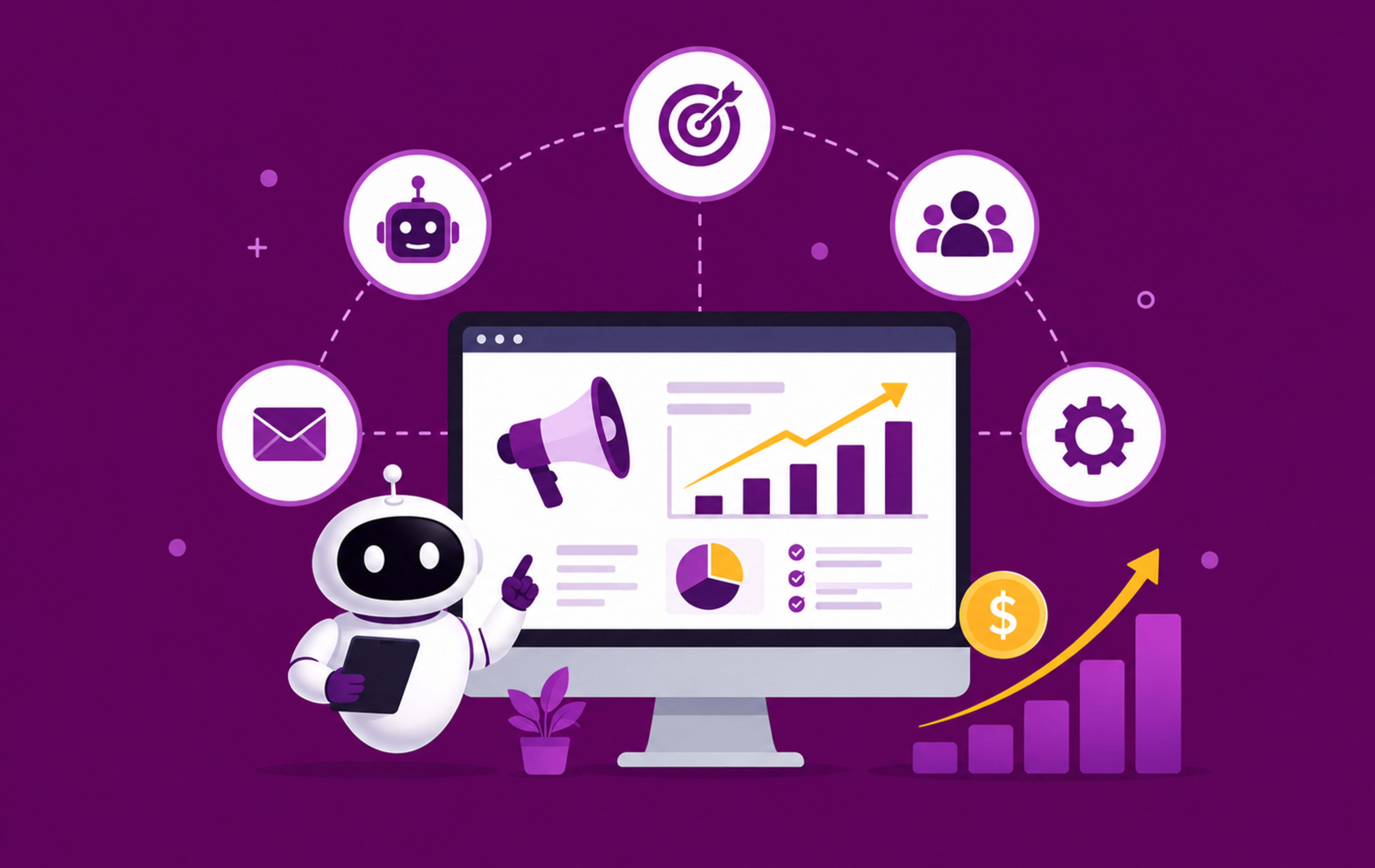

Marketing teams today are kind of expected to do more with fewer channels, more personalization, more data, and somehow also while saving more time. It’s kinda exactly why a lot of growing businesses are leaning toward AI marketing automation tools to stay current. These platforms don’t just kick out repetitive work on autopilot; they add intelligence into the whole process, so marketers can reach better decisions faster.
And if you’ve been sitting there thinking, “Is intelligent marketing automation actually worth the investment ?” this guide is going to walk through the real upsides, with practical examples, so you can figure out whether it fits your growth plan or not.
What Is AI Marketing Automation, Exactly?
At its core, AI marketing automation sort of blends traditional marketing automation with more brainy tricks. So, you know, the usual scheduled emails, workflows, and triggers are still there, but when you add machine learning, natural language processing, and predictive analytics. The result is software that not only runs along fixed rules but also “learns” from what the data shows, adapts to how customers behave, and keeps getting better as time goes on.
Now, compared to basic automation tools that just execute pre-set instructions, an intelligent marketing automation platform can scan patterns across thousands of customer interactions. It can guess what a lead might do next and then tweak the campaign on the fly, while everything is happening. That move from “automated” to “intelligent” is basically what makes these platforms so useful for companies that want to grow without wasting effort.
- Significant Time and Resource Savings
One of the greatest boon of AI marketing automation tools is the time they free up. Many tasks that used to take hours, like bifurcating audiences, keeping up with those social posts, segregating email sequences, or analysing performance, can now be done in minutes.
For growing businesses with smaller marketing teams, this matters a lot. The automation does the heavy part in the background, while people do the smarter parts.
- Personalization at Scale
Customers want personalized experiences, but doing the “hand-crafted” customization for each segment all the time isn’t really realistic once your audience gets past a few hundred contacts. This is exactly where intelligent marketing automation kind of really shines.
With AI-powered platforms, it’s possible to look at browsing behavior, purchase history, and engagement patterns, and then adapt things automatically like:
- – Email subject lines and the email content itself
- – Product suggestions and smarter placements
- – Website experiences, based on what people do
- – Ad targeting, plus the messaging style
- Smarter Lead Scoring and Nurturing
Not every lead is ready to be active, and figuring out which ones actually are is a tedious task without the right kind of data. AI marketing automation tools help with that using predictive lead scoring, basically looking at dozens of behavioral and demographic signals to rank leads by how likely they are to convert.
So your sales team isn’t stuck chasing leads that are more like still warming up; they spend more time on the prospects most apt to close.
- Data-Driven Decision Making
Gut instinct can totally help in marketing, but it really shouldn’t be the only thing steering your overall strategy. Smarter marketing automation systems keep on collecting and interpreting performance information, so you get insights that you probably wouldn’t even be able to put together by hand, at least not in a reasonable amount of time.
These kinds of tools can point out which promotions are actually generating the most revenue, which distribution channels deserve a larger budget, and which messaging pieces land best with particular audience groupings. Over time, you end up with this kind of loop, almost like a feedback mechanism, where your marketing choices get more and more shaped by what the numbers show, instead of relying on guesses or assumptions.
- Improved Customer Experience
Today’s buyers end up dealing with brands in a bunch of places: email, social media, websites, chatbots, and more. Trying to keep that experience feeling similar and still relevant on every channel gets tough fast when your business is growing, and you’re doing it all by hand.
AI marketing automation tools kinda helps pull those moments together by paying attention to customer interactions across channels and then tweaking what gets sent next, not just pushing the same thing at everyone. Like, if someone just checked out a product on your website, they might later get a follow-up email that actually matches what they viewed instead of some generic mass promo send off.
That sort of context, yeah, it matters. When things line up like this, it builds trust and keeps people interested a lot longer.
- Better ROI and Cost Efficiency
Marketing budgets tend to be tight for growing businesses, so it feels like every dollar spent has to count. Intelligent marketing automation helps stretch those budgets even more, mostly because it cuts down wasted ad spend, improves targeting accuracy, and lifts conversion rates with better timing, plus campaigns that are more relevant, kind of on purpose.
Also, a lot of businesses notice that automation can lower the need for added headcount as they scale. Rather than bringing on more people to handle extra campaign volume, the same team can manage a much larger amount of output thanks to AI-driven tools, and it just keeps things moving and cleaner.
- Predictive Analytics for Smarter Campaign Planning
One of the more advanced abilities in AI marketing automation toolsets is predictive analytics, kind of like the capacity to guess what may happen next, based on historical data. In practice that can mean forecasting customer churn, estimating how a campaign might play out before launch, or even pointing out which products a customer group is most likely to pick up next.
For businesses that are growing this foresight is, honestly, quite useful. Instead of waiting until the trends show up already, marketing teams can set things up more proactively, steering their time and energy toward approaches that are statistically more apt to succeed.
- Seamless Multichannel Campaign Management
Coordinating campaigns across email, social media, paid ads, and SMS used to mean juggling multiple platforms and kind of manually keeping things aligned, all at once. Intelligent marketing automation tools pull the whole workflow together, so marketers can manage and fine-tune multichannel campaigns from a single control panel.
How to Choose the Right AI Marketing Automation Tool
With so many platforms out there, picking the right one really comes down to your business size, the kind of goals you have, and also what tech stack you already use. There are a few things that are kinda worth looking at before you commit, and yeah, it’s easy to skip them:
Integration abilities = does it connect cleanly with your CRM, your e-commerce platform, or your analytics tools?
Growth capacity = will it keep up once your contact list expands, and your campaign complexity gets more … intense?
Usability = Can your team actually take advantage of the AI bits without a ton of technical training or retraining?
Insights and insights depth: does it give you real actionable clarity, or is it mostly just surface-level indicators and dashboards?
If you take the time to evaluate those points, it should make it more likely that the tool you end up with actually delivers the benefits we mentioned above. Otherwise, it can turn into another underused piece of software sitting there, quietly collecting dust.
Final Thoughts
AI marketing automation tools kind of shifted from being a “nice to have” to, honestly, a real competitive edge for growing businesses. They help you save time, sharpen personalization, and honestly make it easier to make smarter, more data-backed choices. With intelligent automation in place, marketing teams can do more using the same resources they already have, and that’s the part people often overlook.
And yeah, customer expectations keep climbing while competition for attention gets more intense by the day. So companies that adopt intelligent automation early are usually set up to scale more efficiently… without dropping that personal vibe that keeps customers returning.
If you want to dig into how AI marketing automation tools can actually plug into your growth plan, start by pinning down your biggest marketing bottlenecks or delays. There’s a high chance an automation solution exists that’s built for exactly that kind of problem.

Dental, AI Automation

Dental Insurance Verification Services: How AI Confirms Coverage Before It Books the Appointment
It is 6:40 on a Tuesday evening. A woman with a cracked molar finds your practice on Google, calls, and asks one...
AI Automation, Dental
Dental Office Answering Service: How to Turn Missed Calls Into Appointments
Here’s something most dental practices don’t want to admit: their marketing is probably working better than their phones. They’re getting Google traffic....
AI Automation
AI Answering Service VS Answering Service VS Voicemail: What Actually Books Jobs
Every home-services owner handles missed calls somehow. But the key point is what takes place afterwards. The question is whether you somehow...