







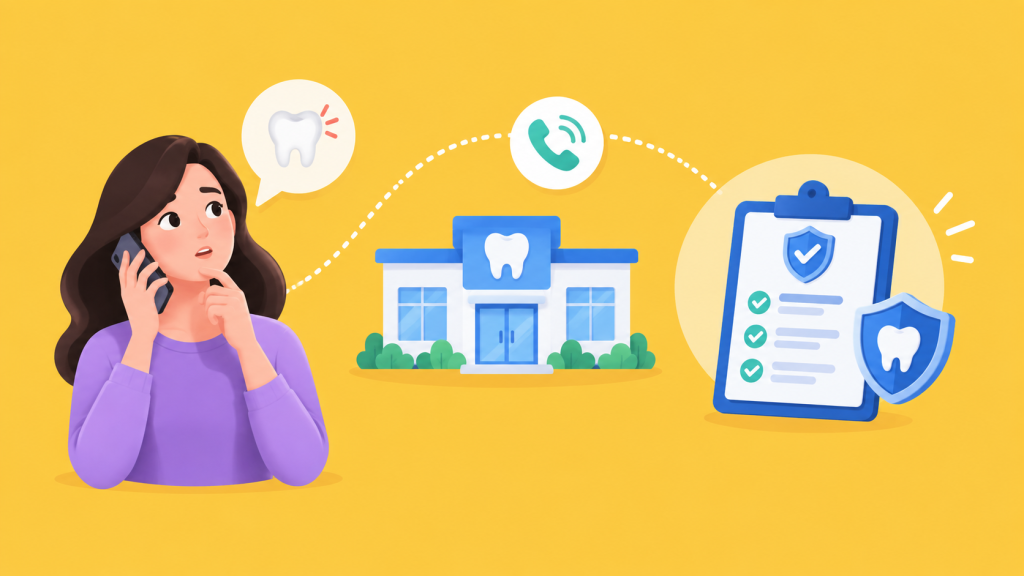
It is 6:40 on a Tuesday evening. A woman with a cracked molar finds your practice on Google, calls, and asks one question before anything else: do you take Cigna? Nobody is at the front desk. She leaves a voicemail, then calls the practice two miles away, who answer and tell her yes.
Dental insurance verification services exist to stop that call from costing you money, but most of them cannot. They confirm eligibility and benefits 24 to 72 hours before a scheduled appointment. That is genuinely useful work. It also assumes the appointment already exists. The caller above never got that far.
This is the gap. Verification is treated as a pre-visit task when it is also a point-of-call task, and the two happen at completely different moments in the patient’s decision.
What are dental insurance verification services?
Dental insurance verification services confirm a patient’s active coverage and benefit details with the carrier before treatment. Some are outsourced teams that work payer portals and make phone calls on your behalf. Others are software that runs automated eligibility checks. Both exist to prevent claim denials and give patients an accurate cost estimate up front.
The outsourced model is the older one. You send your schedule, a remote team verifies each patient, and you receive completed breakdowns before the appointment date. A typical dental office insurance verification company will confirm the policy is active, then document the annual maximum, deductible met to date, coverage percentages by category, frequency limits, and waiting periods. Many will enter that data directly into your practice management software.
The software model runs on the electronic eligibility standard. Under HIPAA, payers must support the ANSI X12 270/271 eligibility inquiry and response transaction, which is what lets a verification tool ask a carrier, “is this policy active?” and get an answer back in seconds. The best dental insurance verification software layers a clean interface and a benefits form on top of that transaction.
Most practices end up with a blend. Software handles the volume. A person handles the exceptions.
Why does a dental office call the insurance company to verify benefits?
Because the electronic response does not contain everything a treatment plan needs. A 271 response confirms the policy is active and returns high-level coverage. It frequently omits frequency limits, waiting periods, missing-tooth clauses, downgrade provisions, and the patient’s benefit history. Those omissions are exactly what determines what the patient owes.
Consider a patient scheduled for a crown. Electronic eligibility tells you the plan is active and major services are covered at 50 percent. It does not tell you the plan downgrades porcelain-fused-to-metal on posterior teeth, that there is a twelve-month waiting period on major work, or that the tooth was crowned six years ago under a five-year replacement clause. Any one of those changes the estimate by hundreds of dollars.
So someone calls. They sit on hold, work through an IVR, and read a benefits form to a representative line by line. This is the least popular task in the front office, and the one most often skipped when the schedule gets busy. It is also the reason insurance verification services exist as an industry at all.
How long does it take a dentist to verify insurance?
An electronic eligibility check returns in seconds. A full benefits breakdown is the slow part. Front office teams commonly report 10 to 20 minutes per patient working portals, and considerably longer when a payer requires a phone call with hold time. Outsourced services usually deliver completed verifications 24 to 72 hours ahead of the appointment.
Those numbers compound quickly. A practice seeing 25 patients a day, verifying only the ones with active coverage, is looking at several hours of work every single day. That work has to happen alongside answering the phone, checking patients in, presenting treatment, and collecting payment.
Something gets dropped. Usually it is the phone.
The timing matters as much as the duration. Every one of these workflows starts from a scheduled appointment. The verification is downstream of the booking. Nothing in the standard process is designed to answer a coverage question from someone who has not booked yet and is deciding whether to.
What breaks when verification only happens before the appointment?
New patients leak out before they ever enter your schedule. The first question most callers ask is whether you take their plan. If your front desk is with a patient, on another line, or gone for the day, that question goes to voicemail. The caller does not wait for a callback. They dial the next practice.
Research on lead response timing found that responding within five minutes makes you roughly 100 times more likely to reach the person and 21 times more likely to qualify them than responding after 30 minutes. That study, led by Dr. James Oldroyd and published through MIT and InsideSales.com, was not about dentistry. The behavior it describes is exactly what happens on a dental phone line.
The practice never sees this loss. There is no report for appointments that were never booked. Your verification service shows a completed queue, your schedule looks reasonable, and the only evidence of the problem is a voicemail box and a phone bill. This is why new-patient capture and insurance verification should be discussed together rather than treated as separate departments.
Can AI confirm dental insurance on a live patient call?
Partly, and the limits are worth stating plainly. An AI voice agent can confirm whether your practice is in-network with a caller’s carrier and plan type, explain your out-of-network policy, quote your new patient exam fee, and book the appointment. It cannot produce a full benefits breakdown during a two-minute phone call.
Here is the honest split.
What can be confirmed on the call:
- Whether you are in-network with that carrier and plan
- Your policy and fees for out-of-network patients
- New patient exam and radiograph fees
- What the patient should bring to the visit
- Whether the plan type you accept matches what they have
What still requires a full verification before the visit:
- Annual maximum and how much remains
- Deductible met to date
- Frequency limits on prophy, exams, and radiographs
- Waiting periods and missing tooth clauses
- Service-level coverage percentages and downgrades
That first list is enough to book the appointment. That is the entire point. The caller is not asking for a benefits breakdown. They are asking whether it is worth their time to come in. Answer that on the call, and the full verification happens later on the normal schedule, for a patient who is now on your books instead of someone else’s.
Any vendor telling you their AI performs complete benefits verification on a live call is describing something the payer systems do not currently support at conversation speed.
In-house vs outsourced vs AI at the point of the call
| In-house front desk | Outsourced verification service | AI at the point of the call | |
| What it confirms | Full benefits breakdown | Full benefits breakdown, documented to your form | In-network status, plan type, practice fees and policies |
| When it happens | Whenever staff have a gap | Scheduled batch, ahead of the appointment | During the patient’s first phone call |
| Typical turnaround | Same day to never | 24 to 72 hours before the visit | Seconds, inside the conversation |
| Staff time cost | 10 to 20 minutes per patient | Minimal after handoff | None |
| What it misses | Consistency when the schedule is full | Every caller who has not booked yet | Maximums, deductibles, frequency limits |
The three columns are not competing. The first two answer the same question at different costs. The third answers a different question entirely, at the only moment it matters to the caller.
How to verify dental insurance benefits: a 6-step front office workflow
The workflow below assumes a practice that wants coverage answered at the call and verified properly before the visit. Each step names who owns it.
- Answer the coverage question during the first call. Maintain a current list of the plans you are in-network with and make it available to whoever or whatever answers the phone. This single step decides whether the appointment exists at all.
- Capture the subscriber details while the caller is still on the line. Subscriber name, date of birth, member ID, employer, and carrier. Chasing this later by voicemail wastes days.
- Run electronic eligibility within 24 hours of booking. Confirm the policy is active before anyone invests time in a full breakdown. A terminated policy caught early is a conversation, not a denied claim.
- Complete the full benefits breakdown 48 to 72 hours out. Frequency limits, waiting periods, remaining maximum, deductible status, coverage percentages by category. Use a standard form so the output is consistent regardless of who completes it.
- Enter the breakdown into your practice management system, not a spreadsheet. The data has to live where the treatment coordinator will actually look for it. If it sits in an inbox, it does not exist.
- Re-verify at the start of every benefit year and after any lapse. January is when stale verification data does the most damage.
What should you look for in a dental insurance verification company?
Judge vendors on four things: whether they write results into your practice management software, how far ahead of the appointment they deliver, what their pricing model is at your actual volume, and how they handle the calls that come in before an appointment is ever booked. That last one is rarely on anyone’s checklist.
Write-back matters more than most buyers realize. A verification service that emails you a PDF has moved the work, not removed it. Someone on your team still has to key the numbers in. Ask specifically whether the vendor enters coverage percentages, maximums, and deductibles into your system, and whether that includes Open Dental integration or whichever platform you run.
Pricing models split between per-verification and monthly subscription. Per-verification is cleaner at low volume and gets expensive fast above a hundred checks a month. Ask for the effective cost at your real patient count rather than the headline rate.
Compliance is table stakes. Any vendor touching patient data needs a signed business associate agreement under HIPAA, and you should ask what security certifications back that up.
And then ask the question nobody asks: what happens to the patient who calls at 6:40 on a Tuesday?
Where ItsBot fits
ItsBot is an AI dental answering service that answers the phone and books the appointment. On insurance, it does one specific thing. It knows which plans your practice accepts, tells the caller directly, and moves straight into scheduling rather than taking a message.
It books directly into your practice management software, so the appointment exists before the caller hangs up and your verification workflow picks it up on the normal schedule. It handles three calls at once, and it covers the hours your team does not, including after-hours call handling and weekends.
It does not replace a verification service. It does not produce benefits breakdowns, and it does not give clinical advice. What it does is make sure the patient asking about coverage is still your patient by the time the breakdown gets done. For more on the calls that never reach a person, see our guide to turning missed calls into appointments.
Frequently asked questions
How do dental offices verify insurance?
Most use two methods together. An electronic eligibility check confirms the policy is active in seconds. A staff member or outsourced team then completes a full benefits breakdown through the payer portal or by phone, documenting maximums, deductibles, frequency limits, and coverage percentages before the appointment.
What is the best dental insurance verification software?
There is no single best option. The right choice depends on your patient volume, which practice management system you run, and whether you need write-back into that system or only a completed form. Evaluate on write-back, turnaround time, per-verification cost at your real volume, and payer coverage.
How long does it take a dentist to verify insurance?
Electronic eligibility returns in seconds. A full benefits breakdown typically takes 10 to 20 minutes per patient through a payer portal, and longer when a phone call is required. Outsourced services generally deliver completed verifications 24 to 72 hours before the scheduled appointment.
Can an AI receptionist verify dental insurance?
An AI voice agent can confirm whether your practice is in-network with a caller’s carrier and plan, explain your fees and out-of-network policy, and book the appointment on the call. It cannot produce a full benefits breakdown live, which still happens before the visit.
The two moments
Verification is not one task. It is a coverage question at the moment someone decides whether to call you back, and a benefits breakdown before they sit in the chair. Most practices have the second one covered and nothing at all for the first. Fixing that does not require replacing your verification service. It requires something that answers the phone.
Hear how ItsBot handles an insurance question on a live call at dental.itsbot.ai.
AI Automation, Dental
Dental Office Answering Service: How to Turn Missed Calls Into Appointments
Here’s something most dental practices don’t want to admit: their marketing is probably working better than their phones. They’re getting Google traffic....
AI Automation
AI Answering Service VS Answering Service VS Voicemail: What Actually Books Jobs
Every home-services owner handles missed calls somehow. But the key point is what takes place afterwards. The question is whether you somehow...
Dental, AI Automation
The Best Dental Practice Management Software an AI Receptionist Can Book Into
Even if your dental practice has the appropriate software, if a patient calls and no one is able to turn that call...