

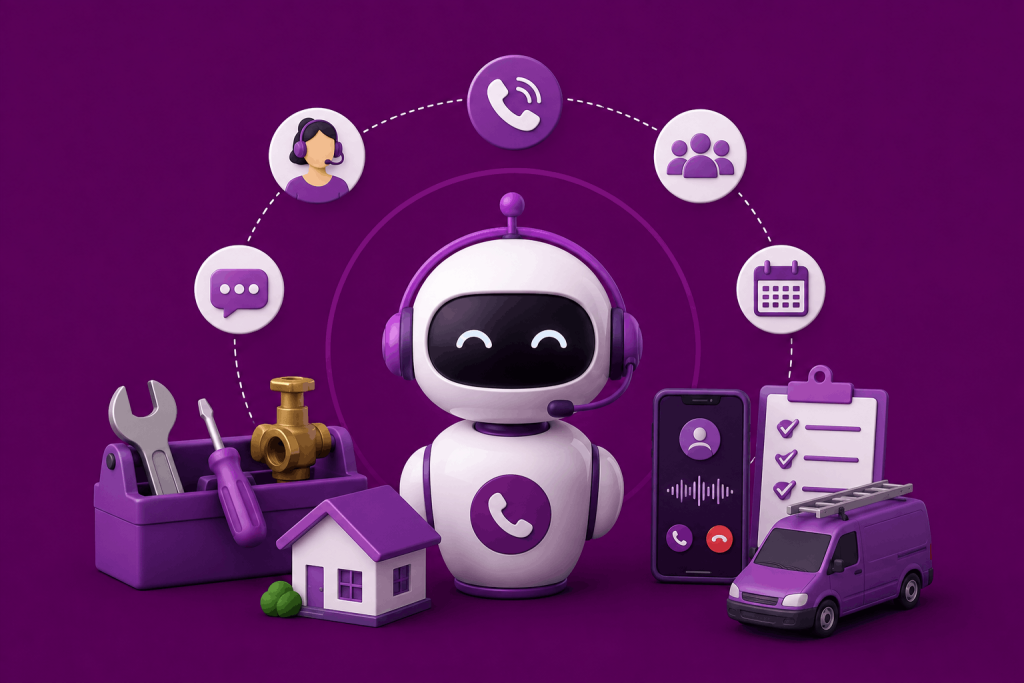

Every home-services owner handles missed calls somehow. But the key point is what takes place afterwards. The question is whether you somehow book the job or just record that you lost it.
A missed call can cost you a customer, even if you have a skilled team of plumbers or electricians. Most people with urgent home issues won’t leave a message and wait. Instead, they’ll call another company.
The three common ways to handle these calls are an AI answering service, a traditional answering service, and voicemail. Each of these has its advantages and disadvantages. We will compare the possible options and clarify when these work best.
The main question is which option will help your business turn more calls into booked jobs?
Voicemail
What it does: records a message if the caller bothers to leave one.
The catch: most of them do not. They hang up and dial the next contractor. Around 85% of people who cannot reach a person never call back. (industry missed-call studies) Voicemail is a log of the jobs you lost, not a way of winning them. It never books anything, never judges an emergency, and never follows up.
Where voicemail shines: Voicemail is great when you handle all calls. If you take five or six calls a week, then call everyone back within an hour, it really works well. Paying for more is just unnecessary. Be honest with yourself about whether you really do ring them back within the hour. But if you do, this is a real answer, and you can stop reading.
A Live (Human) Answering Service
What it does: a person answers and takes a message, usually working from a script you provide. Many offer genuine 24/7 coverage, and the good ones are warm, professional, and pleasant to deal with.
The catch: most generic services cannot see your calendar, so they cannot book. They do not know your trade, so a burst pipe and a routine quote request get the same flat treatment. They answer one call at a time, which means the storm week that matters most is the week they cannot cope with. And you still have to call everybody back later, which means you are still slow, and slow loses jobs.
You are paying, by the minute, for a message pad with a nice voice. Your biggest invoice arrives in your busiest month, which is the month you can least afford it.
Where a human service actually wins, and it genuinely does:
- When the caller needs a human being
A distressed elderly customer. Someone who has been let down and is angry. A bereavement. There are calls where being spoken to by a person is the entire point, and no amount of technology changes that. - When the caller is hard to understand
A strong regional accent, a speech difficulty, a bad line from a building site. A person copes with this better, and pretending otherwise is a lie you would get caught in on day one.
- When the conversation is a negotiation
A complex commercial enquiry isn’t just a phone call; it’s about building a relationship. It should be directed to a person.
If most of your calls look like that, hire a human. We would rather tell you now than sell you something that does not fit.
An AI Answering Service
What it does
Answers on the first ring, 24/7. It gets the call, books the job in your software, and follows up on its own.
The difference
It does not take a message. It takes the booking. It checks your live availability, decides if a call is urgent, and grabs the address and details. Then, it logs the job into your field software and texts the customer a confirmation before they hang up. It then targets cold quotes and lapsed customers. This is money a message service would never reach.
And it answers the second call
And the third, and the fortieth, simultaneously. No human service can do this, no matter the cost. It matters most during key moments: the first cold snap, the morning after a storm, or the day your ad runs.
Where AI actually loses, and here is where we are honest:
- It can mishear
A bad line, a heavy accent, a caller mumbling in a wind tunnel. It happens. What it should do then is admit it, hand off cleanly to a human with the full context, and not guess. Ours does. But it is not the same as a human who just gets it. - It is not a person
For the small number of calls that genuinely need one, it should recognize that and escalate. It is not a substitute for a human being on the call that needs a human being. - It only knows what you tell it
A human receptionist can use judgement about something nobody briefed them on. But an AI virtual receptionist follows your rules. That’s often a strength. It applies rules consistently, even at 3 AM, when a human might not. This is a key difference worth noting.
The test we would apply if we were you: ring it and try to break it. If it can’t handle your calls, you’ll know in ninety seconds for free, rather than finding it out after you’ve signed anything.
Human Answering Service VS AI Answering Service VS Voicemail
| Basis of Comparison | Voicemail | Human answering service | AI answering service |
| Answers 24/7 | It records 24/7, which is not the same thing | Yes, on most plans | Yes, every time |
| Books the job | No | Rarely, and usually only if it is a simple calendar | Yes, straight into your field software |
| Judges an emergency | No | No, unless you pay for a specialist service | Yes, on rules you set
|
| Answers two calls at once | It records two at once | No. One at a time. |
Yes. Unlimited, simultaneously. |
| Knows your trade | No | No, beyond the script you gave them.
|
Yes, trained on your services and rules. |
| Follows up on cold quotes | No | No | Yes, automatically. |
| Handles a distressed or angry caller | No
|
Yes, and better than we do.
|
Escalates to a human.
|
Copes with a very difficult line or accent |
No | Yes, and better than we do.
|
Usually, and hands off when it cannot.
|
| Cost model | Free | Per minute. Your biggest bill lands in your busiest month.
|
Flat plan, based on your call volume. |
Two rows in that table go to the human service. They are real, and we are not going to pretend otherwise.
A Look at the Cost
Nobody publishes prices in this category, us included, and that is annoying. Here’s what you need to know: the three options have very different cost shapes.
- Voicemail is free
It is also the most expensive option in the category for the obvious reasons. - A human service bills per minute
This means your costs go up with your call volume. Your highest bill will come in the month when you receive the most calls, which is when you can least afford it. Storm week is expensive twice. - An AI service is a flat plan built on your volume
It costs the same whether your quiet Tuesday is four calls or your storm Monday is two hundred.
The question is not which is cheapest. It is which one costs less than the jobs it saves. For most trades on our site, an AI service comes in under the value of a single job it catches. For an HVAC install or a roof, considerably under.
Work out your own number rather than taking ours. Here is how:
Which One is a Better Option?
- Voicemail, if you take a handful of calls a week and you genuinely ring everyone back within the hour.
- A human answering service is for you if you often need a person to pick up the call. It works well if you prefer a friendly voice and a message pad, even if that means some trade-offs.
- An AI answering service ensures every call gets answered. It books jobs and follows up on quotes without needing extra staff, especially at 2 AM when you cannot afford to hire.
Do not take our word for the last one. Ring it and throw your hardest call at it. It takes ninety seconds and there is no form in front of it.
FAQs:
Is an AI answering service better than a human one?
For booking jobs, usually yes. An AI answering service sees your calendar and books directly. This requires human services to just take a message to take action later. For a distressed caller, an angry customer, or a genuinely difficult line, a human is better and we will say so. Most home-services calls are the first kind.
Will AI handle emergencies?
Yes. It sorts urgency based on your rules. It sends real emergencies to a human. Also, it focuses on escalating uncertainty instead of solving it. A false alarm costs you a phone call. Getting it wrong costs considerably more.
Is an AI answering service more expensive than a telephone answering service?
Different shape rather than simply higher or lower. A telephone answering service bills per minute, so your cost peaks in your busiest month. An AI answering service is flat, based on volume. Which works out cheaper depends entirely on how many calls you take.
Is an AI answering service just a virtual receptionist?
It does what a virtual receptionist does, and then keeps going. Answering is the first step. Booking, triaging, and following up are the ones that make you money.
What happens when the AI cannot handle a call?
It should tell you, not guess. A good one captures the full context, hands off cleanly to a human, and does not improvise an answer it is not sure about. If a vendor will not tell you what happens in this case, that is the answer
Dental, AI Automation

Dental Insurance Verification Services: How AI Confirms Coverage Before It Books the Appointment
It is 6:40 on a Tuesday evening. A woman with a cracked molar finds your practice on Google, calls, and asks one...
AI Automation, Dental
Dental Office Answering Service: How to Turn Missed Calls Into Appointments
Here’s something most dental practices don’t want to admit: their marketing is probably working better than their phones. They’re getting Google traffic....
Dental, AI Automation
The Best Dental Practice Management Software an AI Receptionist Can Book Into
Even if your dental practice has the appropriate software, if a patient calls and no one is able to turn that call...


