

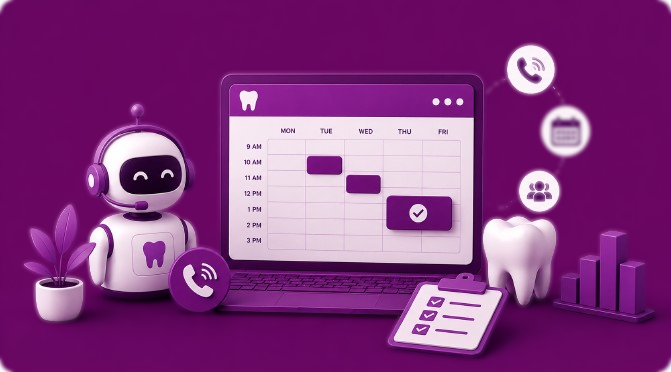

Even if your dental practice has the appropriate software, if a patient calls and no one is able to turn that call into an appointment, then the technology is not doing enough for your front desk. Although most review guides evaluate dental practice management software in terms of charting, billing, imaging, reporting and patient records, these features are important but do not cover one of the most practical aspects of managing a busy practice that is, answering the phone and keeping the appointment book full. In fact, the market shows how rapidly dental practices are moving towards more connected digital systems. The global dental practice management software market is expected to reach $6.8 billion with a 10.6% compound annual growth rate by 2033.
Yet having modern dental practice management software is only one part of the solution. Consider the situation when a new patient calls while your receptionist is attending to someone checking in, assisting a patient at the desk, or is already dealing with another call. In this case, the call might be overlooked or someone will have to break off what they are doing, look at the schedule, identify the correct appointment type and enter the booking by hand. Here the link between your PMS and an AI dental receptionist becomes important.
An AI receptionist is only as useful as the software it can work with securely. It is one thing to answer a call and take a message; it is much more useful when the system can check the available time slots and, if the integration allows it, add the appointment directly to the calendar. This guide examines PMS or dental scheduling software options that use AI to answer the phone and take a patient from a conversation to a confirmed appointment.
Why “Bookable by AI” Matters More Than Feature Lists?
Even if you use the most powerful dental practice management software available, you’ll still miss calls and remain slow to respond to new patients as long as each booking has to be entered by a human. Genuine value is achieved when the phone call and the appointment scheduling go hand in hand.
The successful booking follows a closed-loop process: the call is received, the AI determines what the patient needs, verifies the necessary details, checks current availability, enters the appointment into the PMS, and then sends a confirmation. There is no need for double entry, no unnecessary follow-up calls, and no gaps.
What Does a Bookable AI Workflow Look Like?
They will answer the call: patients will still receive a reply even if the front desk is busy.
- It understands the request. The AI is able to determine what type of appointment the patient wants, whether it’s a cleaning, a consultation, a follow-up or another kind of supported appointment.
- It checks whether there are available times by referring to the practice schedule to find suitable open slots.
- The AI will book the appointment: rather than just taking a message, it will add the confirmed booking to the connected PMS.
- Patients receive confirmation when their appointment is successfully scheduled.
Since routine calls are dealt with more efficiently, the team will have more time available to attend to patients in person, handle complicated questions, deal with billing problems, and look after cases that truly require a human touch.
What Qualities Does Dental Practice Management Software Need for Use With an AI Receptionist?
It is not the case that all PMS function in the same way; the key point is whether the system offers a supported and secure method for another application to interact with its data.
- An Accessible API
An API provides approved software with a means of communicating with the PMS.
For example, the official API documentation of Open Dental enables the retrieval, creation and updating of resources, such as appointments.
- Access to Appointment Availability
An AI receptionist should know the actual available times rather than depending on a fixed schedule. The appointment API of Open Dental has the capability of finding available slots and creating appointments.
- Appointment Write-back
This represents one of the most important points. It is useful to look at the schedule, but the actual gain in efficiency is achieved when an approved appointment is entered back into the PMS.
- Controlled Access
Since dental practices deal with sensitive patient information, the integration should include the relevant permissions and security controls. For example, Open Dental offers separate API permissions for access relating to appointments and patients and states that API developers should enter into a Business Associate Agreement with their clients where applicable.
What Dental Practice Management Software Should One Consider?
There is no one PMS that is best for all practices since the appropriate choice will vary according to the size of the practice, its workflow, budget, and systems it already has.
When it comes to an AI receptionist, the key question is whether the software is able to support the kind of booking workflow you require.
Here are some of the best dental practice management software to consider:
1. Open Dental
Open Dental is a flexible option for integrations, especially when it comes to integration, since it has a documented REST API. Its API lets you check appointment times, make new appointments, and update existing ones.
What this implies is that an approved integration might go beyond just reading information and instead be able to interact with appointment records. Open Dental should be included on the shortlist when assessing dental scheduling software if integration flexibility is important.
2. Dentrix
Dentrix is an established system with API options. It includes a developer program that offers APIs relating to areas such as scheduling and other appointment-related functions. The documentation itself names the Scheduling API and grants approved write access to the supported functions.
The key thing is that compatibility must be verified with regard to the particular AI receptionist and workflow that you intend to use. If you are currently using Dentrix, you might not have any reason to replace it just because you want to have an AI receptionist. You should first check the available integration.
3. Eaglesoft
For Eaglesoft, you should check the actual integration before making your decision. Eaglesoft is also a well-established platform for dental practice management.
With regard to practices that are already using it, the issue in practice is not whether Eaglesoft is able to handle appointments; rather, it is whether the AI receptionist you select has a supported method of interacting with your Eaglesoft system.
4. Other Software Options (Denticon, CareStack, Curve, Cloud9)
The relevance of these platforms will also depend on the kind of practice and its operational requirements.
For dental chains specifically, the need for integration increases as the business expands across different providers, locations, and types of appointments.
What Role Does the AI Receptionist Play in the Dental Practice?
The schedule is held and processed by your practice management software, while the AI receptionist ensures that appointments are booked onto it initially.
- Takes every call: picks up the phone when the front desk is busy, during after-hours, or when it’s impossible to reach the phone.
- It Answers Common Questions: It provides patients with quick answers regarding services, availability, and their next steps without requiring your team to do extra work.
- Confirms the Insurance: Gathers and verifies the important insurance information before the appointment, which helps to reduce the need for back-and-forth communication. It will find the available times and book the appointments directly into your current schedule.
- It Keeps the Workflow Going: The software looks after the calendar while the AI receptionist handles the conversation, which results in the booking.
An AI receptionist completes the process, starting from initial contact till the booked appointment, enabling your team to secure more opportunities.
What Sort of Tasks Can an AI Receptionist Carry Out in a Dental Practice?
The exact capabilities depend on the provider and integration, but common use cases can include:
1. New-Patient Booking
The AI is able to gather basic information and can assist in finding an appointment that is both suitable and available.
2. Existing-Patient Scheduling
Patients do not have to wait at the front desk if they want to arrange for routine appointments.
3. Rescheduling and Cancellations
It is possible to deal with routine changes without staff having to manually handle each call.
4. Appointment Questions
The AI is able to give information that has been approved regarding appointment types, timings and the practice policies.
5. After-Hours Calls
Calls that come in outside the normal office hours can still be answered and directed in accordance with the practice’s rules.
6. Call Routing
If a conversation requires a member of staff, the system will direct the caller rather than attempting to deal with it outside its scope.
An AI receptionist can be used to supplement a dental answering service or an existing front-desk team rather than just being seen as a replacement.
What Criteria Should Be Used to Evaluate the Best Dental Practice Management Software?
Deciding to pick a dental scheduling software solely according to the number of features can make the decision more difficult than it really needs to be.
Rather, concentrate on the way the system functions in your real practice.
Can it check what’s available right now?
The AI must be operating according to the present schedule, not using the out-of-date appointment information.
Can it arrange an appointment?
Find out specifically if the connection enables appointment write-back rather than merely allowing viewing of the data.
Can it follow your appointment rules?
Different types of appointments may need different providers, times, rooms, or scheduling rules.
Can it pass on the call to a person?
A clear handoff from human workers should be part of a good workflow when dealing with complex requests.
What measures are in place to protect patient information?
Before granting any external system access, you should review the permissions, security measures, the way data is handled, and the relevant compliance requirements.
Will this work with the PMS that you currently have?
If your present system is working satisfactorily, then switching to it might cause unnecessary disturbance, and so integration should be looked into first.
What are the Benefits of Connecting an AI Receptionist to Your PMS?
When you connect an AI receptionist to your dental practice management system (PMS), then both your front desk and your AI receptionist will be working from the same schedule. Rather than answering the calls separately and then manually updating the PMS, the AI will be able to deal with conversations with patients and carry out actions directly within your current workflow.
- A greater number of appointments booked: AI is able to take calls and arrange appointments even if your team is busy or the office is closed.
- Less work on the front desk: Routine calls, questions about scheduling, and requests for appointments can all be taken care of without increasing the amount of work for your staff.
- Fewer scheduling errors: Appointments are entered directly into the PMS, which reduces the requirement for manual data entry and duplicate updates.
- The service is available in real time: AI operates according to your own schedule. Patients are given appointment times that your dental practice is able to accommodate.
- Delivers Better Patient Experience: Patients will be able to obtain answers and arrange appointments without having to wait on hold or for a callback.
- Better Use of the Systems You Currently Have: There’s no need to replace your PMS. The AI receptionist will work in conjunction with the various tools that your practice currently uses.
The PMS continues to be the official record-keeping system, while the AI receptionist assists in keeping the flow of both new and returning patients moving from their initial call through to the confirmation of their appointment.
Final Thoughts
It’s no longer sufficient to select a dental appointment scheduling software on the basis of its clinical records, billing, or scheduling features. What actually matters is how well the system integrates with the software used for patient communication.
The aim isn’t always to substitute a PMS that is already functioning. Instead, it is to link the appropriate systems so that a phone call doesn’t automatically turn into another task for the front desk. If an AI receptionist is able to handle routine calls, verify approved availability, and enter the appointment into the current schedule, then the process from “I need an appointment” to “You’re booked” is greatly simplified. A connected workflow helps make the everyday work of the front office easier.
Frequently Asked Questions:
What Dental Practice Management Software Can an AI Receptionist Book Into?
An AI receptionist is able to book appointments into dental practice management software, provided that the relevant integration and API access are available. Some of the best dental practice management software includes Open Dental, Dentrix, and Eaglesoft, along with other PMS platforms being able to offer booking via particular integrations. Make sure that the solution can check live availability and will be able to enter confirmed appointments directly into your current schedule.
Do I need to switch PMS?
Not at all. If the PMS you are currently using is working well in your practice, there is no obligation to replace it. You should first verify that your present system is able to connect with the AI receptionist and supports the booking actions that are required.
What if My PMS is Not Listed?
When you’re having the demonstration, ask the provider about your particular PMS. The availability of integration may vary according to the PMS, its API, or the connection options, and the specific workflow you wish to automate.
Why is Direct Integration Important for Dental Appointment Scheduling Software?
By directly integrating with the actual appointment schedule, an AI receptionist would be able to work with it rather than just taking a message, thus reducing the need for duplicate entries and making the process of getting from a patient’s call to a confirmed booking much smoother.
Can an AI Receptionist Take the Place of a Dental Answering Service?
It isn’t true in all cases. An AI receptionist is able to deal with a lot of routine conversations, whereas a human dental answering service might be more appropriate for practices that wish for people to be involved in each call. Some dental practices may decide to use both depending on their requirements.
Dental, AI Automation

Dental Insurance Verification Services: How AI Confirms Coverage Before It Books the Appointment
It is 6:40 on a Tuesday evening. A woman with a cracked molar finds your practice on Google, calls, and asks one...
AI Automation, Dental
Dental Office Answering Service: How to Turn Missed Calls Into Appointments
Here’s something most dental practices don’t want to admit: their marketing is probably working better than their phones. They’re getting Google traffic....
AI Automation
AI Answering Service VS Answering Service VS Voicemail: What Actually Books Jobs
Every home-services owner handles missed calls somehow. But the key point is what takes place afterwards. The question is whether you somehow...


